Tuesday, October 22, 2013

The Mammy and the Mulatto: The Oddity of Oprah and Obama


     Aside from the dust up between the Dixie Chicks and George W. Bush and the former's disapproval of the U.S. war in Iraq, we have never seen a celebrity beef with the President of the United States that has been so personal as the rumored rift between media mogul, philanthropist, and part-time actress Oprah Winfrey and current Commander-in-Chief Barack Obama.  Because nearly every American resident, including beasts, has some form of access to information and the media (television, internet, newspapers, and word of mouth), I refuse to presume your ignorance by intricately detailing the alleged rift between the two public figures, but I will write an extremely brief synopsis. 

     It is reported that Winfrey declined an invitation to the White House that was to be a gathering of celebrities to promote and support the Affordable Care Act, or Obamacare as it has been labeled by the media pundits (mainly Fox News).  Considering her global influence and likeability played a major role in helping Obama win the 2008 election, I can see how people may believe there to be dissension amongst the ranks of America's Black exceptions.

    What is odd about this alleged rift between the two internationally recognized figures of color is that both of them maintain positions of ethnic/racial exceptionalism in the United States, and for the most part, both of them have a soothing appeal towards white audiences while maintaining a revered, and often times tepid, relationship with the Black American populace.  One would assume that the two of them would be lifelong friends and allies. The irony is that both Obama and Oprah have been whitewashed to an extent by the media so that they are more palpable to a non-Black audience and are upheld as the embodiment of the American Dream; You too can be loved and admired by white America if you do like them--don't be too Black and don't be too Black.
    
     Both of them are bipartisan in their approach to bridging the racial gap in American society, yet it seems that maybe Ms. Winfrey felt her contributions to his campaign, via her constant television and media presence, were to be the precursor of her being privy to White House access, and the receipient of nepotism at its best. Maybe Oprah, for all her success, wealth, and notoriety, forgot that a celebrity endorsement is much different than corporate lobbying for a political campaign.  Donations and support are given in exchange for pushing a lobbyist's agenda.

      What was Winfrey's agenda?  Just to be seen in the White House and on the arm of Barack and Michelle Obama?  Was she trying to grow or seemingly exhausted and ungrowable leviathon of celebrity?  Until now, and I was a child when Oprah hit the national scene in the mid 1980s, I, and probably every other American, has never known Ms. Winfrey's sociopolitical views barring her position on child abuse.  She was building a brand and that brand may have been damaged when after becoming a billionaire and thriving for more than two decades in the entertainment business, she decided to throw herself into America's political arena. Some say backing Obama had affected the success, or lack thereof, of her OWN television network.   Maybe she thought her position in America's hierarchical structure was higher than it really is. She is a celebrity and philanthropist.  Plain and simple.  She is not a politician or one of the invisible hands that clandestinely governs the nation's government, people, and economy.  She is a Black, female billionaire who lent her voice in support of Obama's 2008 presidential campaign.  He won in 2008, was reelected in 2012, and no longer needs her stamp of approval.  And just maybe, America's favorite talk-show host is upset and thus, declined his latest invite. 

     The conundrum of being a Black "exception" is that one often believes their exceptionalism should be celebrated, if not deified, by all--even other Black exceptions.  American media posited Oprah as a rotund, congenial comforter of sorts for her viewing audience ala Mammy while the same media, and political, machine posited Obama as the congenial mullato that can literally appeal to the dichotomy of America's racial makeup--Black and white.  Each of them has achieved enormous success in their respective fields and serve as measuring sticks for their contemporaries and standards of success for their less fortunate, less wealthy, and less famous Negroidian brethren, but do not seem to realize that they have no need to be beefing if that's what it really is.  I mean, who really turns down an invite from the POTUS?  Oprah.  That's who? Oh, and former Chicago Bears defensive tackle and Hall of Famer Dan Hampton.

                                                                                                                   -Gee Joyner

Thursday, September 12, 2013

Twerk, Miley: Ownership of the Female Body


First, I am exhausted with the term ‘twerking’(which is also spelled with an ‘i’ or ‘u’ before the ‘rk’ in the English colloquial lexicon). I believe society is exhausted with twerking. But most of all, I feel “some type of way” about Three Six Mafia member Juicy J offering a $50,000 scholarship to the “best twerker” via his Twitter account. In the words of the hit Rap/Hip Hop song, “Some Type of Way” by Rich Homie Quan, Juicy’s benevolence “makes me feel some type of way.” The mere fact that Jordan Houston aka ‘Juicy J’, a native and fellow Memphian like myself, and a Grammy award winner, has taken to cyberspace to reward an educational scholarship, though he did not specify what he meant by ‘scholarship’, to the best twerker, and I am assuming he means ‘female’ twerker, has me conflicted. Like any other blue-blooded heterosexual man on planet Earth, I have no problem with being a voyeur or audience member to a female body gyrating and moving her hips and mid-section at a rapid, sometimes slow, and sensual pace, but I do find it off-putting to offer a woman money, particularly for a presumed educational opportunity, solely because of her ability to “twerk”and, subsequentially, sexually arouse a male with money—Juicy J in this case.
          To surmise the history of twerking, one will find its origins in the New Orleans bounce music scene of the early 1990s, specifically DJ Jubilee’s “Do the Jubilee All” in which he chanted, “Twerk, baby, twerk, twerk, twerk.”  The dance, which involves the fast or slow gyrating of the buttocks and hips, spread from the clubs to the strip clubs and became immensely popular in the notorious strip clubs of Atlanta and Houston. Hip Hop took twerking mainstream with the Ying Yang Twins’ 2000 hit single “Whistle While You Twurk”.  Since then, numerous popular Rap artists have mentioned the term “twerking” in their lyrics.  The term seems to be synonymous with the exhibitionist and voyeuristic, if not sexually lustful denigration of the female body.  And because of the aforementioned, rapper Juicy J has chosen to further perpetuate the notion that the worth of women is restricted to their ability to sexually satisfy men—be it through physical sex or the simulated act thereof.     

          My internal conflict and psychological conundrum lies in my gift and my curse in viewing almost every single nuance of not only my life, but society as a whole, from a ‘scholarly’ lens, which I believe, be it naivety or ignorance, most people do as well.  The question is whether it is a woman’s civil and human right to do whatever it is she wants to do with her body as long as it is not physically harming another.  The debate of female sexuality as a tool of empowerment has been at the forefront of our social morays since slavery, and it has been adopted as one of the main talking and selling points of the woman’s suffrage, feminist, and womanist movements and the intersectionality of the aforementioned.  Sure, no individual, particularly and specifically those of the male gender, should be the comptroller of the female body, but when, if ever, does the autonomy of the female body and the movements thereof become explicit? In addition, should women participate in the exploitation of their bodies when it is often grossly displayed on the grand stage of American media as a tool of amusement and an embodiment of female subordination, subjugation, and degradation? 

           Upon first seeing Miley’s adventures in twerking, via YouTube, I thought she was just another white artist stealing from the Black American canon of entertainment, and after her performance at the MTV  Video Music Awards in Brooklyn, New York, I was sure she was mimicking the likes of Elvis, the Rolling Stones, and Justin Timberlake, but I have reanalyzed and redirected my position on Ms. Cyrus—she’s just “doin’ her” which is what any artist or person has the God-given right to do.  Sure, she is not the best twerker in the game, and it may merely be a gimmick to destroy the shadow of Hannah Montana and offer herself up to the world as a grown-up (musical) artist.  Nevertheless, I believe Miley may be embracing the autonomy that women at the forefront of female equality have created for her.  Who knows?  Maybe somewhere in America Gloria Steinem and Alice Walker are twerking their tails off.

                                                                                                           -Gee Joyner 

Thursday, July 18, 2013

Georgey Had a Gun: One Woman's Thoughts on Race and Racialized Thinking


There has been no shortage of material written about the George Zimmerman trial since the jury handed down their decision Saturday evening. Social media sites, Twitter, the blogosphere, and the internet in general was lit ablaze the second the public heard that a verdict had been reached, and the number of articles posted since then has amounted to nothing less than a deluge.

A friend told me Tuesday evening that she had been checking my Facebook page since Saturday to see what I had to say about the verdict. She indicated that she looks to me (among others) for insights on certain matters, and that she had noticed how “quiet” I’d been. I was honest with her, stating that I had stayed off of Facebook entirely, neither reading statuses nor posting anything myself. This was because I was too hurt, too discouraged, and too angered by what had happened on Saturday, and by what has and hasn’t happened since then, although I wasn’t surprised by the verdict. Instead of responding in the heat of the moment, I decided it would be best to reflect and pray until I came to a place where I could speak clearly, firmly, and lovingly.

So here is my contribution to the mix. What follows are things that I’ve been thinking about for many years. Keep in mind that my thoughts are not just about Trayvon Martin and George Zimmerman. My remarks are, however, confined to the US (although much of what I have to say speaks to the human condition) because this is where I live, this is the place that I know the most about, and this is what I have spent my adult life studying, teaching about, and writing on. I have also limited my comments to the issue of race, although there are many other kinds of “isms” I could discuss. It is my hope that people read this thoughtfully. I pray that everyone can take something useful away from this. I hope that people can lay aside their defensive postures and be honest with themselves, and with God, in the quiet meditations of their heart, if nowhere else.

1. While it’s true that race (and ideas about race) is/are “socially constructed,” it’s equally true that race (and racialized ideas) has/have real consequences in terms of peoples’ life chances and treatment. Being racially sensitive, then, does not mean being “color blind.” It means understanding our nation’s history, and acknowledging that that history has endowed many of the persons who live here with certain privileges and protections by virtue of their birth. It has also imbued everyone who is born here, or who moves here, with ideas about other people based on race and/or ethnicity, really based on birth and appearance when you get right down to it (i.e. Indians are good at math and science, Chinese people are bad drivers, black women are promiscuous and on welfare, Muslims/Arabs are terrorists, etc.). These ideas have become so deeply engrained within the fabric of our political, economic and social systems, and our national and individual psyches, that many people no longer question them, try to understand how and why these ideas arose, and (frighteningly) are often not even aware that they hold racialized ideas. That’s what makes “culturally institutionalized racism” so dangerous: it has become invisible to many of those persons who benefit from and help to perpetuate it.

2. Racialized behavior today does not LOOK the way it did in 1863, or 1963. It is no longer about federally legalized slavery, internment camps, and attack dogs. It isn’t about openly segregated schools, laws against intermarriage, or the accepted usage of words like “Chink,” “Spic,” or “Nigger.” That doesn’t mean that negative, fearful, or condescending ideas about “the other” have ceased to exist. All of us engage in “othering” people every single day. Whether we cross the street when we see a homeless person, or choose not to live in a certain neighborhood because of “bad elements,” most of us think and behave more like the Levite from Luke 10 and less like the Samaritan on any given day. The fact is that racialized thoughts (stereotypes, if you will) still exist; they are just expressed in more subtle, and thus more insidious, ways than in years past. It’s no longer cool (in most circles) to be a bigot, so few people today admit to being racists, or acknowledge that they hold certain, unflattering beliefs about entire groups of people. This is also partly because people in 2013 compare their behaviors to those of virulent racists and segregationists from the past who openly enslaved, terrorized, and lynched Latinos/as, Blacks, and Asians. That’s why everyone I know says, “I’m not a racist.” They would never use racist slurs or promote legalized slavery, but their ideas on certain issues reveal that they have been impacted by institutionalized racism and have internalized nationally held, racialized ideas. It’s just that these ideas are now articulated with a different language. Instead of using words like “Jap,” “Wop” or “Wetback,” people currently discuss “criminals,” “welfare recipients,” “drug dealers,” “immigrants,” and “the lazy poor.” While the language has changed, the fact is that ideas about the inherently negative predilections and/or behavior of “those people” remain.

3. Having one Muslim friend, one black friend, or one Asian friend doesn’t mean you can’t or don’t hold prejudicial beliefs about a larger group, or prevent you from being a conveyer of racialized ideas. It’s very easy to make “exceptions” to the rule and include one person in your social circle. What you’re really saying (perhaps unconsciously) is that that one person is not like the rest of “THOSE people.” They’re like YOU, whether that means middle-class, white, Christian, straight, educated, American, or something else. They make you feel comfortable. They don’t challenge you, or make you feel guilty. They talk like you. They dress like you. They’re “DIFFERENT” from the rest of “THOSE people.” You can thus accept them, and even love them, while continuing to adhere to racist ideas about the larger group to which that person belongs. You can also accept one racial group while harboring negative ideas about another.

4. Only George Zimmerman knows how he truly feels about black people. We can surmise (based on his personal history of 911 calls and other facts in evidence) that he, if nothing else, mistrusts black men. This is why he followed Trayvon Martin. He thought that he was a shady individual, not because he knew anything about Martin as an individual, but because Martin was a young black man in a hoodie. Zimmerman thus engaged in what we would call racial profiling (being suspicious or fearful of someone and concluding that they are “out of place” and possibly dangerous simply on the basis of their looks). At the very least, Zimmerman thus appears to have been affected by our nation’s historical creation and transmission of racialized ideas about the fearsome, criminally inclined, black male body.

5. Only George Zimmerman knows what really happened that night last February. We will never hear both sides of the story because Trayvon Martin is dead. What we do know is that Person A followed Person B in a car down dark and rainy streets; that Person A got out and pursued Person B on foot through yards, alleys and bushes; that Person A and Person B had a verbal confrontation; that Person A and Person B eventually fought; and that Person A, who instigated the entire incident by following someone AGAINST POLICE ADVICE, shot Person B, who did not have a firearm. Person A didn’t shoot Person B in the kneecap, fire a warning shot in the air, or club Person B over the head with the gun. Person A killed Person B.

6. If I were Person B, I would fear Person A, REGARDLESS of their race, age, or gender. I don’t know anyone who wouldn’t. Be honest. If you were followed by a stranger at night and then confronted by them, you would run, and you would shout, and then you would fight back to protect yourself by kicking, punching, clawing, and scratching. I know that I would defend myself as best I could, in any way that I could. Fearing for my life, I would STAND MY GROUND, just as I would if someone broke into my house. Under these circumstances, whether Person B threw the first punch is irrelevant. Person B would have never had to throw a punch if Person A hadn’t stalked them in the first place. Nobody should be allowed to instigate an altercation, kill someone when the fight doesn’t go their way, and then claim self-defense. We should all be horrified by this verdict. We should all be terrified by the vigilantism it may inspire (no matter who we are in terms of age, race, gender, religion, educational achievement, wealth, or geographic location). This verdict says that who we are as individuals is irrelevant. Instead, who we (as Person B) APPEAR to be in the mind of Person A is all that matters.

7. My words are not written in order to make persons who belong to groups of inherent birth-privilege “feel bad.” Let me be blunt: white guilt is pointless. White allies, however, are priceless. I write in hopes that persons with racial privilege who read this will acknowledge that while neither they (nor I) created the system, we are all impacted by it. I hope they will admit that white people today still benefit from this system in numerous ways, often without realizing it, even if they don’t ask for or want it. Only when each of us (particularly those persons who have inherent privilege) acknowledges that the differentials and dynamics of racialized thinking still exist will we be able to work together to start the healing process and create new ways of thinking, seeing, and behaving. Sticking our heads in the sand has only perpetuated the problem and caused it to change shapes, to morph if you will, and go underground. Racialized thinking, like any other sin, thrives in fear, darkness, and silence. As my historical heroine, Ida B. Wells, stated so long ago, “The way to right wrongs is to turn the light of truth upon them.”

Let me conclude by speaking from my heart. I long to hear more on this issue from those persons of privilege who profess Christ, yet who have been heartbreakingly silent since Saturday (and even before). I long for the day where women won’t instinctively clutch their purses when my black male friends walk by. I long for the day when my friends and I won’t be disrespected in restaurants or followed in high-end stores by nervous sales clerks. I long for the day when nobody considers not having children because they can’t bear to see their sons and daughters subjected to racialized stereotypes. I long for the day when no parent has to have THAT conversation with their child, the conversation that explains racism to them and teaches them how to respond to racialized thoughts, words, images, and actions. I long for the day when NO CHILD has to endure what my man’s 5-year old daughter experienced last week when another 5-year old girl in her gymnastics class said to her, “I can’t touch you. I’m allergic to black people.”

Perhaps I am naive to think that such a day is possible…this side of heaven. Still, I am unwilling to abandon this world to such evil, or abdicate the responsibility I have to shine a light into dark spaces through my words and my actions. I know that I am not alone in this, and I look forward to partnering with and working alongside any person, no matter their race, ethnicity, religion, gender, sexual orientation, nationality, language, etc. who are interested in furthering the cause of humanity and justice for all persons.

                                                                         
                                                                                      - Dr. Amrita Chakrabarti-Myers

Wednesday, May 22, 2013

Finger Lickin' Good: Sergio Garcia vs. Tiger Woods and America's Acceptance of Ethno-Specific Stereotypes


I grew up in the South.  Germantown, Tennessee to be exact.  And never in my life have I met anyone, who is a meat-eater, decline fried chicken.  From the days of frying it in a slave-cabin-like skillet in thick, white Crisco to using vegetable oil, the devouring and digestion of fried chicken has been a staple of American society since I can remember, particularly in the South—by Black and white Americans. About twenty years ago, my father was diagnosed with High Blood Pressure and we no longer had fried foods for dinner.  I adopted that diet and probably only eat fried foods four or five times a month.  The rest of my dietary palate is saturated with grilled foods.  I mean, seriously, I literally grill four or five times a week. But, I say this because I do not understand how eating fried chicken can be connoted with Blackness or be deemed a stereotype that maintains any validity.  As a lecturer, writer, and college professor, I have the opportunity to travel several times a year, all over the U.S.A., and whether I’m in the Northeastern, Southern, West, or Midwest regions, I always see several chicken shacks, restaurants, or diners that all serve (and often times openly promote on their windows or signs) fried chicken. 
So, when I woke up this morning and viewed ESPN’s Sportscenter and read the remarks of PGA golfer Sergio Garcia, who has had a long-standing feud with golf God, and arguably the greatest golfer of all time, Tiger Woods, quip, after being asked would he have Tiger over for dinner during a tournament next week, while at the European Tour’s gala players’ awards in London, England, “We will have him round every night.  We will serve fried chicken”, I not only found it offensive, but I found it extremely lame, unfounded, and assimilatory at best. Clearly, Sergio riffed his pathetic-at-best attempt at humor, and internalized hatred for Blacks, or at least the ones who dare play and excel at the gentleman’s game of golf, from golf legend Fuzzy Zeller’s book of racist remarks who, during the 1997 Masters, stated in reference to Woods’ winning of the tournament, “So, you know what you guys do when he gets in here? You pat him on the back and say congratulations and enjoy it and tell him not to serve fried chicken next year.  Got it?...or collard greens or whatever the hell they serve.”
            Stereotypes, particularly those of an ethno-specific origin, have existed for ages, and I often times laugh at them even when aimed at Black people, but this particular jibe from Sergio Garcia made me think a bit more.  Who is Sergio trying to impress?  Why would he mention fried chicken when attempting to belittle Tiger Woods?  Tiger is Black and Asian, and even a little ‘white’, correct?  Didn’t he once refer to himself as a Caublasian? (Funny how he seemed to create his own ethnic hierarchy within the name—Caucasian, Black, and ‘then’ Asian, but I digress)  What Sergio and all the non-Black people of the world need to know about the American Negro is that the frying of the chicken derived out of necessity.  For the most part, during American slavery, the only livestock the African American was ‘allowed’ to raise was the chicken.  True, there may be a pig or a hog here or there, but the chicken, as we all know, breeds in abundance and can be devoured from the rooter to the tooter.  As far as the frying of the poultry, I can only assume that it was a quick and easy way to prepare the main course of a more than likely paltry meal, and the grease, along with the flouring of the bird, made the chicken stick to one’s bones and increased the caloric intake due to the meat being fried in lard or grease,  and that was needed considering the laborious activities that the slave had to endure during those twelve to fourteen hour work days.  Oh, and it tasted great!
            But, I feel that Garcia is trying to ingratiate himself to a particular audience which is ironic seeming that he’s already been accepted by mainstream white PGA followers and advertisers.  It is reported that he has made over 43 million dollars during his time on the PGA tour, received over 16 million dollars in endorsements last year alone, mainly TaylorMade Adidas, and has been on the tour since 1999, so I am not sure if this particular distasteful ‘joke’ of his was an attempt to assimilate to the culture of American golf.  It is apparent by his name and accent that he is of the Spanish persuasion, though Spain is a European country, and his physical aesthetics would place him in the vague category of ‘white’, but his use of the fried chicken remark leads me to believe that his cultural and ethnic insecurities prompted him to further prove himself to the powers that be or that he ‘belongs’ with the powers that be—and in the world of golf, those powers are Anglican whites. 
            The tone of the media seems to be dismissing this blatant racist joke from a professional and international athlete as if we should just let it blow over or “move on from this” as was suggested by the PGA.  Why should we, as Black and non-Black people, just “move on”?  In the past month alone, Black scholars, particularly Dr. Boyce Watkins, launched campaigns against and boycotts of  Lil’ Wayne because of his insensitive, sexist, and derogatory lyrics referencing the lynching of Emmitt Till and Tyler the Creator’s alleged stereotypical portrayal of Black Americans in a commercial for Mountain Dew to which both individuals subsequently lost their endorsements from PepsiCo/Mountain Dew.  Should we give Sergio Garcia a pass?  Why, because he aesthetically resembles the ethnic group that resides atop America’s socioeconomic hierarchical structure?  Nope.  Adidas, we have a problem.  Follow suit and distance yourself from anyone who would utter such foolishness in a public forum.  Swing that golf club, win, smile on a commercial, and say the politically correct things or shut up. 
            Lastly, research your ethnic jokes before you make one.  Fried chicken actually originated in Scotland and England.  Fritters have been around for hundreds of years and the Scotts fried chicken and actually brought that practice to the U.S. South in the 18th century.  For that matter, fried chicken was a major staple in West African cuisine, and we all know that more than 80% of the African slaves were bought or kidnapped from the west coast of the African continent so I imagine he is somewhat correct in his comprehension of History and the nuances and the practices derived thereof.  Yet, like I stated above, Sergio’s joke is unwarranted.  If there is some negative connotation to one’s diet consisting of or including fried chicken, the Scottish should be more offended than the Negro, Mr. Garcia.  I suggest he stick to playing golf because History is not something he seems to be familiar with. 
 
                                                                                                 Gee Joyner


Wednesday, May 1, 2013

Don't Ask. I'll Tell It: NBA Player Jason Collins Goes and Tells It on the Mountain


     It is no secret that Americans, if not the entire world, maintains an ideological belief that the male athlete is a superhero of sorts.  A man that has extraordinary physical abilities that allows him to do things with his physical appendages that the majority of us mere mortals can only exhibit deep in the gallows of our minds via a vicariously voyeuristic perversion that is truly alive when we watch the athlete perform on the grid iron, diamond, or hardwood.  And because of these extraordinary abilities, the athlete is able to garner attention, accolades, and a massive bank account only rivaled by Fortune 500 CEOs, entertainers, and sheiks.  The aforementioned is where the conundrum of male homosexuality in sports morphs into a leviathan of hypocrisy, xenophobia, and even exceptionalism.  We, as a viewing and paying audience, want to be able to control our heroes.  We want our hero/athlete to be just like us, and if he is not like us or doesn’t prescribe to our social, ideological, and religious belief system, we feel duped.  We feel manipulated.  We feel conned.  In America, we like those whom we support to do as we say and what we want them to do, and at the least, we want them to conform while they perform.  Jason Collins, the 12-year veteran center for the Washington Wizards, has done all of these things, yet while he is being lauded as an activist for Gay Rights, he is being condemned, and further marginalized, just the same.

      Though Collins is no all-star nor a future Hall of Famer, the fact that he is a highly paid, professional athlete makes his disclosing of his sexual orientation (or sexual preference, depending upon you subjective perception of homosexuality) newsworthy, blog worthy, and fixture in media and social networking circles—at least for the time being.  What is interesting is that since President Obama’s public stance in support of Gay marriages our nation has been inundated with dialogue, both positive and negative, concerning not only Gay marriage, but homosexuality in general.  And, that is a good thing. And Jason Collins’ “coming out” in the revered public sphere of American athletics/sports is, by some means, another way to champion the rights of gays as well as breaking down barriers of discrimination so many homosexual Americans endure, both explicit and implicit, on a daily basis. Collins’ Sports Illustrated article in which he outed himself by stating, “I am Black…and I am gay” seems to suggest that he is somehow correlating the discrimination and inequality heaped upon the African American with the homosexual experience which seems to be far reaching.    And, I’m not so sure, “coming out” can be juxtaposed to other forms of inequality that are solely based upon one’s physical aesthetics.

     How can an employer not hire you if you are a homosexual if they do not ‘know’ you are a homosexual? Maybe I am a proponent of ‘don’t ask, don’t tell’? Maybe your sexuality and sexual activity should be a personal thing, like your mate’s G-Spot or the fact that you abuse your wife or husband or children, either mentally or physically, or that you chug down a bottle of Smirnoff every evening after work to make it to the next day, or that you nasally scoff down five or six lines of Peruvian on a nightly basis to cope with your inadequacies, or that you eat a ‘family size’ platter of Popeye’s chicken while locked away in your bedroom to satisfy your pleasure principle. In my opinion, some things should be an individual’s own business.

        I am concerned that when Gay individuals compare their movement to that of the African American Civil Rights Movement they are minimizing the sociopolitical and economic restrictions that exist when discriminatory actions persist because of one’s appearance. Black don’t come off, but you can hide Gay. For instance, unless one walks around adorned in the androgynous garbs of an Adam Ant or 1980s…and 1990s…hell, 2000s, you would be hard-pressed to readily identify one’s sexual preference via the natural visual aid we call appearance.

      Are Gays, or is the LGBT, community piggybacking on the Civil Rights Movement? Yes, I know that Gay Rights are nothing new to the national agenda, yet I get sick of hearing the comparison between the two movements. I mean, really? How in the world is being ‘gay’ at the least similar to being Black. I can’t hide my hue or the tint of my skin or the permanent tan I’ve had from birth—Gays can. Sure, you will eventually have to bring your mate to the company picnic or the company Christmas Party or whatnot, but I can never leave my Black at home—no way no how. Sometimes, if I could, I wish I could leave my Black at home while searching for a prestigious position at an elite company that will afford me the opportunity to pay off student loans, for the two degrees and graduate certificate which I have earned, and garner me enough of an annual salary where I can properly provide for my son and his college education and first car and prom and attire he can wear to school without being ridiculed by his classmates for not having upper middle class garments and summer vacations abroad, but I cannot; I cannot hide my Blackness—you can see it in my skin and in the juicifully thick lips and kinky, black hair. And my walk and the base and rhythmic intonation of my voice and my…’cool.’ Gays can hide their sexuality. Even if they bring their mate to a company outing or out in public, who’s to say the two, or the couple, are not just close friends, or friends? People know me and my ‘Blackness’ aren’t friends—they know we are one—one in the same.  And I know everyone reading this article will reference the U.S. Miscegenation laws from 1913-1948 where 30 of 48 states enforced a ban on interracial marriage and the 1967 Loving vs. Virginia case where the Supreme Court ruled the Virginia Racial Integrity Act of 1924 unconstitutional and readily compare that one aspect wherein the Civil Rights and Gay Movements intertwine. But sexual preference, and the ability to display one’s sexual preference, and one’s race are incomparable like shit to fart—they both smell, but one is of substance and the other is just gas. There is a reason why old adages exist like ‘that’s like comparing apples and oranges’ or ‘that’s neither here nor there’—because arguments like this one fit that bill.

     On the contrary, or to assume the role of devil’s advocate,  The “coming out” of the first active same-gender-loving athlete in a major American sport has highlighted the matrix of misogynistic and patriarchal prevalence.  The imperial romanticism of male genderizing has stitched a skewed stereotype in our minds of what masculinity is and looks like.  As Collins makes his public projection, much of the buzz around is all is that fact that his body politic dismantles the stereotypical male queer.  Imagine this 7-foot, 255 pound gargantuan marching in the next gay pride parade.  This affirms our psychological and theological fears because our xenophobia and homophobia is grounded in a mythical sense of normativity.  The reason that Collins’ remarks have gotten so much attention is because our culture cannot help but admit our fixation and fascination with male sex and sexuality (especially when posited in the lions of the black body).  Much of this is grounded in our understanding of God and the Divine (more will be expressed in this regard later).

     Furthermore, since most of us suffer from a psychological and sexual deviance and lopsidedness rooted in conquest and not complementarity or sincere adoration, we are sexually scratching and clawing to maintain our social and societal privileges.  I believe these privileges (male and heterosexual) are the baseline for the suicide laps Chris Broussard attempted to run in his responsive commentary.  The problem with his reflection, however, is that it has been affirmed by a group of people that he arguably indicted along with his condemnation of Collins’ sexual orientation.  Broussard grounds his ideology in his theology while committing a common brand of biblical idolatry.  To use the bible as a source of discrimination is farcical and all too normative. 

     In the midst of the tragic irony, several of Broussard’s supporters have lorded and affirmed his critical commentary while missing what Broussard would arguable call “the plank in their own eye.”  Broussard’s approach to biblical sexual ethics indicted many people who condemned homosexuality along with him but cast aside his equal opportunity offense of premarital sex (which by definition of several “supporters” Facebook profiles, pics and posts they are willing participants in).  To be clear, Broussard has a human right to interpret his theology as he understands it. We all have a biased and subjective construction of spirituality.  But Broussard is misguided in thinking there is a clear definition of Christianity in a bible that has a testament canonized that preceded the birth of the “Christ.”  The early Hebrews were not Christian and Hebrew testament (which is part of the bible might I add) is not reflective of Americanized, Westernized and Europeanized views of the faith (even if they are spewed out of the mouths of black commentators). 
     But I applaud that Broussard was attempting to be an equal opportunity offender.  Sadly, however, people don’t take any offense to him indicting people who are sexually active (heterosexually) and unmarried.  This could be because people feel his analysis of heterosexuality is insufficient do to the cultural norms of promiscuity and sexual liberation.  But those same people feel his pseudo-bible based belief relative to same gender relations is spot on.  Go figure.


     The truth is, the biblical context of sexuality ("adultery", "fornication" and "homosexuality") has been skewed and sadly misinterpreted for centuries. For instance, we equate adultery and fornication as "sex outside of marriage" but that is NOT the "Biblical" concept. The "Biblical" concept is that sex to a married Hebrew woman is adultery. However, men could have as many wives as they wanted, and sleep with as many non-married women, Hebrew and otherwise, as they wanted. Fornication was, conceptually, "sex for hire" or sex with a prostitute and was frowned upon Biblically because it usurped financial power from males and empowered females. The bible gives us no real "sex education" (i.e. Adam and Eve have sex and conceive Cain - was that the first time they had sex? Who told them how to "do it"? Why isn't it mentioned? Because the bible isn't concerned with sex and sexuality like we are... In other words, the bible projects sex as a means of procreation and human control through conquest.  Paul said that “it is better to marry than to burn.”  In essence, this suggests that if you are having problems with “lust” or promiscuity, the best thing to do would be to get married.  How would you like that for premarital counseling today?  Again, the bible is a BAD PLACE TO GET OUR SEXUAL EDUCATION! So let’s not try to use theology as a justification for negative critics because Jason Collins and any other same gender loving person is courageous enough to “go tell it on the mountain.”
 
 
*A Collaborative Rhetorical text by Rev. Earle J. Fisher and Gee Joyner/ The Pastor & The Professor


Sunday, January 20, 2013

Them Niggas Got Shot: The Disturbing Idolatry of King & Obama


I’m sure I’ll be rhetorically crucified in cyberspace by the American Negro.  I am almost positive this text may have an adverse effect on my personal, and. possibly, professional networks and even my occupation.  But I must do this.  I must write this.  I must continue writing this piece in order for me to rid myself, and my constituency of an internal and explicit hypocrisy.  A few times a year I travel to scholarly/academic conferences and listen to presentations of the numerous nuances of the ills of the “Black American Community” or the “Black Problem in America” or “What Blacks Need to Do Better” and I get disgusted, fidgety, and begin to feel out of place.  Just as out of place as I did when I was in elementary school when I was always the only Black kid in the class, or at recess, and, sometimes, at lunch.  The majority, in my opinion, was the other.  I guess you could say that I had reverse-xenophobia. 

I always feel socially uncomfortable with the gullible or those who revel in media interpretations of an event or an individual.  Dr. Martin Luther King Jr. was a man of principles and a man of flaws. Just like Barrack Hussein Obama.  Except King’s social infidelities are more widely known because of J.Edgar Hoover (i.e. whore mongering, marital infidelities, sexual deviances, if you will—he allegedly patronized prostitutes per Hoover and the late Rev. Ralph Abernathy).  Yet, we all must understand, that Obama, just as Dr. King, is and was human.  I fear that too many of us laud these men’s secular accomplishments and deem the two to be deities in a sense as it pertains to the Black American struggle and pseudo-triumph over U.S. racist institutions (i.e. social, economical, and political). 

  I have been mildly entertained and hugely perturbed by cyber-debates that give analyses as to whether President Obama should be publicly sworn into office on the nation’s reserved federal holiday for Dr. Martin Luther King Jr. and the analogous anecdotes of irony that have inundated Facebook posts and the Twittersphere.  Many believe that it is only fitting that the first Black President of the United States is being sworn in on the King holiday and will be sworn in with a bible which once belonged to Dr. King to take the oath.  The ironic thing to me is that we, as a very informed and knowledgeable audience, are even comparing the two men.  One is a prophet at the least and the other is a politician at best.  One dedicated his adult life to the Black Civil Rights Movement, as well as the Poor People’s Movement and the anti-war effort concerning the United States’ involvement and occupancy of Vietnam, and the other is a politician whom, whether it is in his heart or a mere political agenda to sway voters, has fought for women’s and LGBT rights and is a  warmonger by default (no U.S. politician can be elected Head of State without a plan for “national security” which is political jargon for U.S. protection via war and the possibility of war). 


Regardless of how much symbolism the two men have in American and Black American History, neither one of these men, in my estimation, would have or wants to be deified by the public as a Negro messiah.  Whether we like it or not, considering most Black Americans are Christians, neither King nor Obama are Jesus Christ.  King did not die for our sins and I seriously doubt Obama plans on it either.  But both men do bring a static, and, sometimes, fluid symbolic metaphor of the struggle and triumph of  the American Negro—liberation from physical enslavement, the lynching of Jim Crow, the dismemberment of occupational strongholds, ethnic redlining in real estate, and the desegregation of schools across the country, and Black politicians, and, now, a Black President.  The aforementioned has deconstructed the narrative of these two men, and their symbolic representations of the Black American struggle and experience in America and recomposed it as a myth of sorts.  No one individual or idea of an individual garners as much reverence in the Black community as Jesus, Dr. King, and now, Obama (Growing up, every Black grandmother I knew had a painting of ‘The Last Supper’, a portrait of Jesus and Martin Luther King on their living room or dining room walls).
 
Matthew 24:5 (KJV) states, “For many shall come in my name, saying I am Christ; and I shall deceive many,” which is indicative  of how many Black Americans, particularly Generation X and Baby Boomers, have posited both Dr. King and President Obama—as saviors of the entire race.  Not to say that King was a false prophet or Obama has a malevolent political agenda, but these men should not be lauded as a Christ or a messiah who the Black Americans have been waiting for.  What these men are and represent is the Chocolate Horatio Alger Theory embodied in their rhetoric and the social and political courses of their lives.  Each wanted change.  One for his people.  One for his country.  What’s ironic is that King was Black and Obama is of mixed heritage.  Does that not cover the gambit?   And the ideologies of both men seem to be a way of compensating and being individual freedom fighters for people of all ethnicities that reside in the U.S. of A.  King used social change and the injustice of Blacks in America to affect political change (Civil Rights Act of 1964).  Obama used politics to affect social change (his public support of Same Sex Marriage in the  summer of 2012). 
On this day, January 21, 2013, before comparing ideological beliefs and the social relevance, importance, and impact of these two symbols of the Black existence and contribution to the United States, how about we all just reflect on those invisible, Black backs that paved the way, often times with blood, sacrificed their time and efforts and intellect, and, sometimes, their lives like a Christ-like figure should or would that, if not for them, we wouldn’t even know Martin or Barack.  In Chris Rock's stand-up comedy movie "Bigger and Blacker", he juxtaposed the murders of rappers Tupac Shakur and the Notorious B.I. G./ Biggie Smalls with the killings of Dr. King, Malcolm X, and President John F. Kennedy.  Rock says that King, X, and Kennedy were assassinated, yet, in comparison, as for Tupac and Biggie, "Them niggas got shot."  Maybe we shouldn't elevate the poster children for Black achievement and Black change as deities.  Maybe we should laud those daily grinders and grassroots workers as our sociopolitical heroes--be it your pastor, teacher, local community activist or civil servicemen, or parent(s).  In the end process, those who oppose the totality of human equality and opportunity will always subscribe to the ethnic hierarchical structure of the U.S. that has perpetually posited the Negro as an outsider and holistically inferior.  And if you asked them about King, or Obama, they'd say, "Them niggas got shot."  King literally and Barack metaphorically in that he will always be wounded by and bogged down with the weight of having had been the second coming...of Dr. King.
 
                                                                                          -Gee Joyner


Monday, December 31, 2012

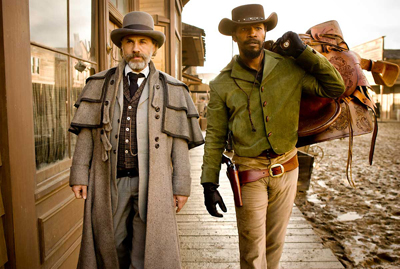
That Damn Django!


It's hilariously frustrating to me how many public Black scholars and intellectuals and professors of History, Sociology, Literature, and the like, not all, but some, are intent on criticizing Quentin Tarantino and even Jamie Foxx, for their creation/writing/imaginative composition and participation in 'Django Unchained', yet most of the aforementioned Black voices, who are from either America's Generation X or Baby Boomer generations, laud other Black actors and actresses for their involvement and, sometimes, creation of cinematic Black caricatures. (i.e. Alex Haley and Ron O’Neil via 'Superfly').  In my opinion, Tarantino was and is not trying to rewrite Black American History by no means; the man is a writer and director of cinema that attempted, successfully I might add, to tell a love story via the lens of integrating the Hollywood genres of the spaghetti Western and Blaxploitation films.

            As a matter of fact, Tarantino is not only telling a love story, but he is also telling a story of vengeance and proper reparations that posits the Black male as a non-subordinate figure who is a prototypical hero of American cinema—Django is a John Wayne in a sense because he plays by his own rules and is the antithesis of the subservient Negro or subordinate slave of the times in which the movie takes place (1858), described as being “a rambunctious sort” by Leonardo DiCaprio’s character Monsieur Calvin Candy, the slave planter/owner of the Candyland Plantation which, through dialogue, constructs and brings to the forefront the notion that the Black male wasn’t as docile, timid, and fearful of the white patriarchal system. One could even argue that this piece of dialogue even deconstructs the notion of the Antebellum South’s totality of control of the Black male psyche and physical body.  Django does what most slave films do not—show the white slave master and all of the whites that exist in the vacuum of dehumanization getting what they deserve—death, and a violent one at that.

            But Tarantino has done something in American cinema that we haven’t seen in cinematic abundance since the 1970s—he has positioned the Black man as an American Cinematic Hero to audiences of all hues. What is profoundly important is that Tarantino’s Django exists in an era of American History, a troublesome era at that, rather than in an apocalyptic or futuristic era that deems alien beings as the other and objects of xenophobia or in a world where base survival is the most important nuance of life and one’s race is all but obsolete (e.g.  the Black heroes in alien takeover films or the post-apocalypse ‘Book of Eli’).  In a nutshell, ‘Django Unchained’ reintroduces the Black, cinematic hero to audiences that were not privy to the Black Exploitation heroes like Superfly, Shaft, Goldie, or Slaughter.  And because of Tarantino’s bankability, the creation of a Django may very well be the impetus for the reconfiguration of Hollywood’s casting of the Black male.

  Unlike the ‘Blaxploitation’ or ‘Black Exploitation’ films of the 70s, which were mainly viewed by and profited from majority Black audiences, ‘Django Unchained’ is being viewed, celebrated, and financially compensated via the pockets, wallets, and coin-purses of not only Black, but white audiences as well.  Quentin’s Hollywood bankability, directorial respectability, reputation, be it good or bad, and fame affords this film the opportunity to be distributed, accepted, and lauded by audiences and critics of all socioeconomic and ethnic residences.  You could say, ‘Django Unchained’ is the Hollywood’s ‘Roots’, a television network’s production, as it pertains to accessibility and availability of consumption. 

By no means am I writing as some sort of white apologist for the exploitation of Black American life or the Black American experience, but I am writing in defense and support of a film that redirects how Black and non-Black audiences view of a leading Black man or hero.  Django is neither subservient nor in need of Dr. King Schultz’ (Christopher Waltz), the white bounty hunter with whom he works, aid and assistance in saving him from a violent predicament or unwanted quandary (e.g. the Rush Hour franchise).  And he doesn’t die!  Django is all man:  dirty, rugged, tough, physically savvy and skilled, if not supernaturally accurate, in the art of handling a firearm.  Everything the American viewing audience has been conditioned to believe, endorse, and promote from the prototypical white American gun-slinging hero. 

And as far as the argument that is circulating on blogs and the web concerning the politics of gender constructs, can we not posit the dystaxy or "cinematic flashbacks" to Broomhilda (Kerri Washington) and Django's love for her as the "main character"? For example, the entire premise of the movie is one man's longing for the "present" not absent love of his wife. Sure, the male protagonist is the hero, yet the hero is fueled both emotionally and physically by the memory and the longing for his wife.  I believe this revisionist cinematic piece of History disseminated via a cinematic representation is just as profound and potent and important as Tarantino’s ‘Inglorious Basterds’ which is ironic in that I didn’t hear many Jews complaining about that film (please see Dangerfield Newby or John Brown’s raid on Harper’s Ferry to see the similarities between Django and Newby as a historical reference).  If I had an extra arm and hand I’d give this film three thumbs up.  It’s worth the time, money, and intellectual analyses. 
                                                                                                          -Gee Joyner